Web interfaces

Accessing FcLigand features through a web browser: The performance of calculations and graphical rendering was evaluated in a client-server web architecture using the Blazor framework (open-source framework from Microsoft to create web user interfaces based on components using C# and HTML). Blazor leverages WebAssembly technology developed by the World Wide…

Continue reading

Our commitment to Corporate Social Responsibility in 2023

Promoting women’s rights with Cité des Droits des Femmes association: In 2023 we were proud to initiate activities at Felix Concordia to promote human rights, which is one of the seven core subjects of the ISO 26000 international standard for social responsibility, a CSR guideline. We became the first corporate…

Continue reading

Enhancements on Bioisosteric replacement

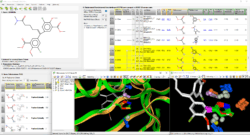
FcBioisostere new graphical features to better explore bioisosteric PDB based pairs: This year we extanded the FcBioisostere software to better sort the precalculated 3D bioisosteric pairs extracted by our application from the PDB Protein Data Bank. Same topological pairs are now grouped together to help users assess a statistical suitability…

Continue reading

Introduction to FcPipeline

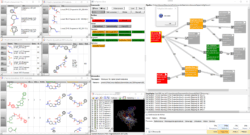
Designing protocols with a workflow user interface: In order to faster design new protocols for users in our C2P Chemo-Proteomic Platform, we investigated technical solutions to provide a sketcher to users to design predictive protocols similar to a workflow. FcPipeline our new module under development provides a full set of…

Continue reading

Working on COVID-19

Proof Of Concepts to annotate protein surfaces and generate drug candidates: Since the beginning of the COVID-19 pandemic crisis, the scientific community has generated an amazing amount of data especially in structural biology with more proteins together with cocrystallised ligands of fragment probes. We ran our 3D intermolecular surface miner…

Continue reading

FcLigand FcRebuilder FcBioisostere & FcTools new releases

Code standardization in C# for agile developments: To streamline our software development processes, we decided this year to migrate some of our components to C#, our primary programming language. By bypassing dynamic serialization, we gain advantages in speed, memory usage, and enable full polymorphism for data types throughout the code.…

Continue reading

FcLigand v1.0.16

Major new release of the FcLigand software: Today September 9th 2019, Felix Concordia announces the new release v1.0.16 of the FcLigand drug design software. A major effort was invested for the last two years (1) to provide a better usability with harmonized methods and tracing report per molecule, (2) to…

Continue reading

FcRebuilder to predict ligand bound conformation

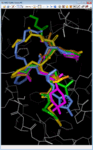
Mining ligand common substructures in biostructures: Today May 15th 2018, Felix Concordia announces the first release of the FcRebuilder, an alternative software solution to existing docking technologies for Drug Discovery in pharmaceuical R&D. FcRebuilder predicts partial to full ligand 3D bound conformation in binding site(s) by mining the PDB biostructural…

Continue reading

a C2P-API application: Rebuilding ligand in binding site

Poster presentation at the 2017 Groupe de Graphisme & Modélisation Moléculaire conference (Reims, France):  Fast software development in drug design with the C2P-API toolkit : Rebuilding ligand bound conformation from PDB subpocket superpositions Abstract: Literature in the FBDD field reported cases where the binding location and orientation of small co-crystallized…

Continue reading

EuroQSAR-2016: poster on 3D ligand reconstruction by mining PDB

Mining PDB Subpockets to Rebuild Ligand Binding Conformations

We constituted a database of subpocket-fragment complexes (Fragmentor) through deconvolution of each PDB (Protein Data Bank) ligand in all possible fragments that match one of the chemical molecule contained in the Pubchem database. After application of a Matriochka filter, we obtained a set of 28.482 2D-fragments and 398.236 3D-fragments (PDB conformations). Subpockets were defined as protein surfaces located at 4,5 Å around fragments.

The goal of this work was to determine if there is enough information in the PDB to successfully rebuilt the binding mode of ligands, starting from the target protein structure. To test this hypothesis, we selected ligands in unique PDB entry to build a test set of 2292 protein-ligand complexes and tried to recover the position and conformation of the ligands using our Fragmentor database. We were able to predict at least 80% of the 3D-structure from 1091 ligands (48%). In conclusion, this study highlights the quality of the information contained in the PDB and supports the use of its structural information for docking tools or fragment-based drug design.

Click here to download the PDF poster